Introduction: why every business faces this question
When a company decides to launch a website, the first decision usually sounds simple: use a website builder or commission custom development from scratch. In reality, this choice involves a whole set of factors — budget, timeline, long-term scaling plans, and design and functionality requirements. In 2025, the choice between no-code and custom development has become even more relevant: website builders have matured significantly, while the cost of custom development keeps growing alongside increasingly complex business requirements.
In this article, we break down the difference between no-code platforms (using Weblium and Tilda as examples) and custom development, walk through real cases with approximate pricing, and help you determine which approach fits your project.
What is no-code website development
No-code is an approach to building websites through visual builders without writing code. Users work with ready-made blocks, templates, and a drag-and-drop editor, while the entire technical layer — hosting, SSL certificates, mobile responsiveness — is already built into the platform.
The most popular no-code solutions for the Ukrainian and European markets include:
- Weblium — a Ukrainian website builder focused on small and medium businesses. It includes built-in marketing tools, payment integrations (LiqPay, Stripe, PayPal), and a full-featured e-commerce module.
- Tilda — a popular platform known for its design-first, block-based structure, often chosen for landing pages, portfolios, and media projects.
- Webflow, Wix — international alternatives offering broader design customization but a steeper learning curve for beginners.
The main advantage of these platforms is speed: a basic website can be assembled in a few days, sometimes even hours.
What is custom development
Custom development means building a website or web application from scratch by a development team, with its own architecture, codebase, and infrastructure. In this case, the business gets full control over functionality: any business logic can be implemented, from CRM integrations and personal accounts to booking systems, custom analytics, or Telegram automation for lead processing.
Modern custom development — for example, on a Next.js, React, PocketBase, and Node.js stack — allows combining the launch speed once exclusive to builders with the flexibility of code, thanks to reusable components the team adapts to a specific project rather than building everything from a blank slate.
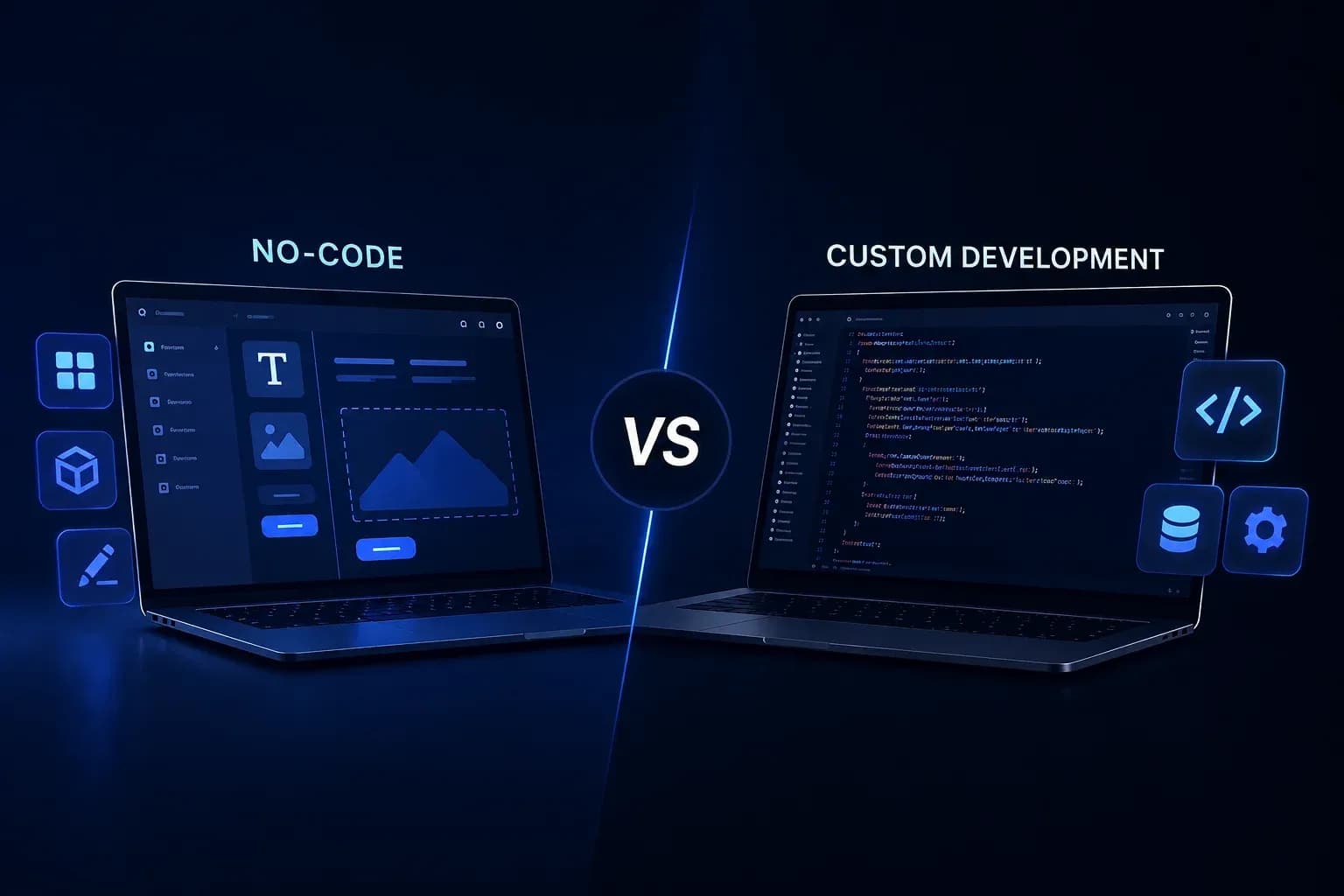
No-code vs custom: direct comparison
Criterion | No-code (Weblium, Tilda) | Custom development |
|---|---|---|
Launch timeline | 1 day to 2 weeks | 3 weeks to several months |
Starting cost | Low: $10–100/mo plan + designer's work | Higher: depends on project complexity |
Functional flexibility | Limited by the platform | Unlimited — any business logic |
Code ownership | None, site lives on the platform | Full, code and data belong to the business |
SEO capabilities | Basic, sufficient for most sites | Full control over technical SEO |
Scalability | Difficult under growing load | Built in at the architecture stage |
Integrations | Limited, pre-built set | Any API or service |
Support | Platform-tier support | Dedicated development team |
When a website builder is enough
A website builder is the optimal choice in these situations:
You're testing a business hypothesis. If you need to quickly validate demand for a product or service, there's little point investing a large budget in custom development. A Weblium landing page can start collecting leads within days.
Budget is limited. For startups, freelancers, and small local businesses (cafés, beauty salons, tutors), a builder covers the basics — a presentation site, a contact form, a service catalog.
There's no complex business logic. If the site doesn't need personal accounts, multi-role booking systems, or custom integrations with internal company systems, a builder handles it without issues.
The team wants to manage content independently. Visual editors like Weblium and Tilda let a marketer or business owner make edits without involving a developer every time.
When custom development is necessary
Switching to custom development becomes justified when:
The project requires complex functionality. SaaS platforms, CRM systems, marketplaces, booking services with dynamic pricing — all of this goes beyond what builders can offer.
Design and UX uniqueness matter. Builders rely on pre-made blocks, so sites on the same platform often share a similar structure. If the brand requires a fully original interface, a custom frontend is needed.
You're planning to scale. If you have a small product catalog today but expect traffic to grow 10–50x within a year, the architecture should be designed correctly from the start — migrating from a builder to custom code later is significantly more expensive.
Deep integrations are required. Connecting to ERP systems, custom CRMs, banking APIs, or logistics systems can only be achieved with custom code.
SEO and load speed are business-critical. Builders impose technical limitations on site speed (heavy JS, generated markup), while custom development on a modern stack like Next.js allows achieving top Core Web Vitals scores — a direct Google ranking factor.
The hidden cost of no-code solutions
An important nuance often overlooked at the start: the cost of a builder isn't limited to a monthly subscription. Over time, additional costs accumulate:
- Paid plugins and feature extensions;
- Limits on the number of products, pages, or traffic on lower-tier plans;
- Payment processing fees built into the platform;
- Migration costs to a custom CMS once the business outgrows the builder's capabilities.
As a business grows, the total cost of ownership (TCO) of a no-code solution over 2–3 years often approaches the budget of custom development — without the benefits of owning the code.
Real cases and approximate pricing
Case 1. Landing page for a local business (café, salon) Task: single-page website with a contact form and service catalog. Solution: Weblium, StartUp plan. Timeline: 3–5 days. Approximate cost: $150–$400 (design + content), excluding the $9–15/month subscription.
Case 2. Corporate website for a B2B company Task: multi-page site with a service catalog, blog, contact forms, and basic Telegram automation. Solution: hybrid — Weblium or custom Next.js development depending on design requirements. Timeline: 2–4 weeks. Approximate cost: $650–$1,600.
Case 3. Online store with 500+ products Task: e-commerce site with a cart, payments, personal account, and inventory system integration. Solution: custom development (Next.js + PocketBase/Node.js), since builders are limited in inventory integration flexibility. Timeline: 6–10 weeks. Approximate cost: $2,000–$5,300.
Case 4. SaaS product or CRM system Task: web application with user roles, subscriptions, and analytics. Solution: custom development only. Timeline: 3+ months. Approximate cost: starting from $6,500 and up, depending on complexity.
A hybrid approach: combining both options
The choice isn't always strictly either/or. A hybrid model is often optimal: the marketing part of the site (landing page, blog, presentation pages) is built on a fast builder or a lightweight custom frontend, while complex business logic (personal accounts, CRM, booking system) is built as a separate custom application integrated with the main site via API.
This approach lets you launch the marketing side quickly and affordably, while investing in custom development only where it's truly critical for the business.
How to choose the right option: a checklist
Before making a decision, ask yourself a few questions:
- Do you need unique business logic that isn't available in ready-made templates?
- Are you planning significant traffic or catalog growth over the next 1–2 years?
- How critical are load speed and technical SEO for your business?
- Do you have the budget to invest in custom development now, or should you first validate the hypothesis?
- Do you need deep integrations with external systems (ERP, banks, logistics)?
If you answered "yes" to most of these — custom development is worth considering. If "no" or "not sure yet" dominate — start with a builder and scale later.
Conclusion
No-code and custom development aren't competitors — they're tools for different tasks. Builders like Weblium and Tilda are ideal for fast launches, hypothesis testing, and small businesses with limited budgets. Custom development becomes necessary when a project requires unique logic, deep integrations, and readiness to scale.
The main rule for 2025: choose a solution based on real business goals, budget, and planning horizon — not trends. The ABECT team works in both directions — from fast Weblium landing pages to complex custom web applications on Next.js and PocketBase — and can help determine the right approach for your project.